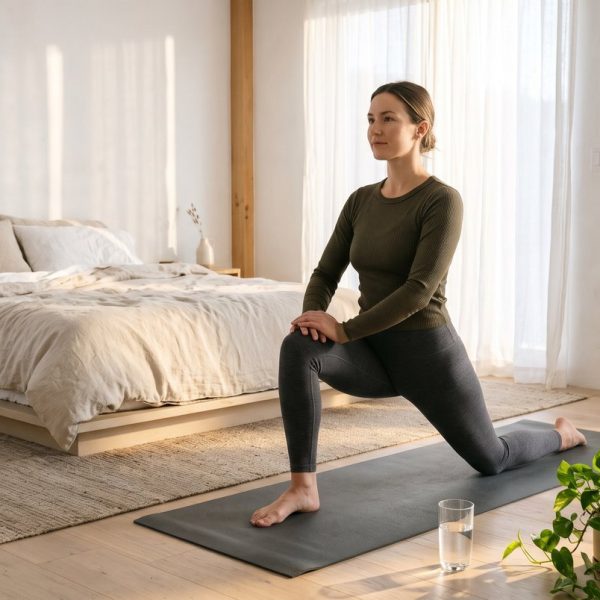
Most people who tell me they "don't have time for yoga" are picturing a 90-minute class across town. A morning yoga routine asks for far less. Fifteen minutes on a mat beside your bed, done before the phone comes out, can change how your back, your breathing and your mood carry you through the rest of the day. After years of teaching beginners, I can say with some confidence that the short daily practice beats the occasional long one almost every time.
What follows is the sequence I give new students who want to start the day well. It needs no props beyond a mat (a folded blanket works), and every pose has an easier option.
Why a Morning Yoga Routine Works So Well
Overnight, the body stiffens. The spine has been still for hours, the hips have been folded or flat, and breathing has been shallow. Gentle movement first thing reverses that slowly instead of forcing it, which is exactly what a sleepy nervous system needs. There is also a practical argument: mornings are the one part of the day most of us still control. Evening plans get cancelled, meetings run late, but the ten or fifteen minutes after you wake up tend to stay yours.
Research summaries from the US National Center for Complementary and Integrative Health note that yoga may help with stress, sleep quality and low back discomfort for many people, while also reminding readers to adapt poses to their own body. That last point matters. A morning practice is not a performance. It is a check-in.
Before You Begin
Drink a glass of water, open a window if you can, and set a timer so you are not watching the clock. Move slowly. If anything pinches or feels sharp, back off to the easier version or skip it. If you have an injury, are pregnant, or are managing a medical condition, speak to your doctor or a qualified teacher before starting a new routine.
The 15-Minute Morning Flow
1. Easy seat and breath (2 minutes). Sit cross-legged on a cushion so your hips are slightly higher than your knees. Rest your hands on your thighs and breathe in through the nose for a count of four, out for a count of six. The longer exhale is the quiet signal to your body that there is no emergency, only a new day.
2. Cat and cow (1 minute). Come onto hands and knees. As you inhale, let the belly drop and lift your gaze. As you exhale, round the spine and tuck the chin. Let the breath lead the movement rather than the other way round. This is one of the simplest yoga stretches for waking up the whole back.
3. Downward-facing dog (1 minute). Tuck your toes and lift the hips. Bend the knees generously in the morning; straight legs can wait until you are warm. Pedal the feet slowly, one heel then the other, to ease the calves.
4. Low lunge, both sides (2 minutes). Step one foot forward between the hands and lower the back knee to the mat. Lift your chest and, if it feels good, your arms. Hip flexors shorten during sleep and during long days at a desk, so this pose often brings the biggest sense of relief.
5. Half sun salutations (3 minutes). Stand at the front of the mat. Inhale and sweep the arms overhead, exhale and fold forward with soft knees, inhale to a flat back with hands on the shins, exhale to fold again, then inhale all the way up. Repeat five or six times. This is a gentle version of the classical Sun Salutation, the sequence that gave many morning practices their shape. Its Sanskrit name, Surya Namaskar, is a reminder of the old roots of the practice, and if you are curious about the languages behind so many pose names, these interesting facts about Hindi make a nice starting point.
6. Standing side stretch (1 minute). Reach both arms up, hold one wrist, and lean gently to the opposite side. Breathe into the long side of your ribs, then switch.
7. Supine twist (2 minutes). Lie on your back, hug your knees in, then let them fall to one side while your arms rest open. Turn your head the other way if your neck allows. Twists are a kind way to finish, because they release the spine without asking much effort.
8. Short rest (3 minutes). Stretch out flat, palms up. Do nothing. Many students want to skip this part, and it is the part they most need. Three minutes of stillness lets the body register what you have just done.
Morning Yoga for Beginners: Making It Stick
The hardest part of any routine is day eleven, not day one. A few habits help. Leave the mat unrolled where you will see it. Practise at the same time each day, even if that means just the breathing and one stretch on a busy morning. Keep the sequence identical for at least two weeks so you are not deciding what to do while half awake. And notice small changes: easier stairs, fewer aches after a long drive, a calmer first meeting.
Yoga also pairs well with other training. If you already lift weights or run, a short morning flow becomes a natural warm-up for the body you rely on later. For readers who want to build out the rest of the week, these gym workout plans that fit any schedule combine nicely with a daily stretch.
A Small Practice With a Big Return
A morning yoga routine will not fix everything, and it does not need to. What it offers is a steady, repeatable way to arrive in your own body before the day asks anything of you. Start tomorrow with fifteen minutes. If that is too much, start with five. The practice grows with you, and the mornings tend to get a little easier as it does.